LED screens have become the mainstream display solution for commercial advertising, stage rental, corporate exhibitions, retail stores, and public signage worldwide. With the continuous upgrading of LED display technology in 2026, the market features a wide range of products with different parameters, quality levels and prices, making it easy for buyers to make wrong choices and cause budget waste or poor display effects.
This complete LED screen buying guide sorts out 8 core purchasing factors covering scenario matching, parameter selection, cost budgeting and after-sales service. It helps beginners and professional purchasers quickly lock in suitable LED display solutions and avoid common purchasing pitfalls.
1. Application Scenario: Indoor VS Outdoor LED Screen
The first step of LED screen selection is to confirm the installation scenario, which directly determines all core parameters such as brightness, waterproof grade and structural design of the display screen.
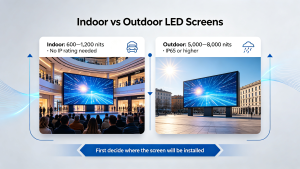
Indoor LED Screen
Designed for closed and stable indoor environments (shopping malls, conference rooms, exhibition halls, indoor stages), it requires no weatherproof and dustproof design. With low ambient light interference, it only needs conventional brightness to present clear and soft pictures, avoiding eye irritation caused by excessive brightness.
Outdoor LED Screen
Adapted for open-air environments exposed to sunlight, rain, dust and extreme temperatures (outdoor billboards, street signage, scenic spot displays). It must support high-brightness display and reach IP65 and above waterproof and dustproof rating to ensure stable operation in all weather conditions.
Quick Selection Tip: Choose indoor models for fully enclosed installation environments; prioritize high-brightness, high-protection outdoor models for semi-outdoor and open-air scenarios.
2. Pixel Pitch: Core Parameter for Picture Clarity
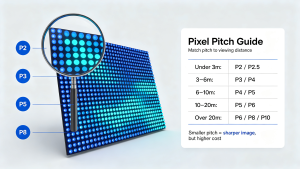
Pixel pitch refers to the center-to-center distance between two adjacent LED pixels, which is the most critical parameter affecting display clarity. The smaller the pixel pitch, the higher the screen resolution and the finer the picture details, but the higher the overall cost. The most scientific selection standard is to match the pixel pitch with the actual viewing distance.
2026 Recommended Pixel Pitch Matching Standard (By Viewing Distance)
|
Minimum Viewing Distance
|
Recommended Pixel Pitch
|
Applicable Scenarios
|
|---|---|---|
|
Within 3m
|
P2 / P2.5
|
Conference rooms, high-end exhibition halls, indoor live screens
|
|
3m – 6m
|
P3 / P4
|
Shopping mall atriums, indoor stage backgrounds
|
|
6m – 10m
|
P4 / P5
|
Large indoor venues, supermarket publicity screens
|
|
10m – 20m
|
P5 / P6
|
Outdoor plaza screens, community publicity displays
|
|
Above 20m
|
P6 / P8 / P10
|
Large outdoor billboards, roadside advertising screens
|
Avoid Pitfalls: Excessively large pixel pitch leads to obvious particle and pixelated pictures; blindly pursuing ultra-small pitch will cause unnecessary budget waste.
3. Brightness Matching: Ensure Visible Effect in All Light Environments
Brightness is measured in nits (cd/㎡), which determines whether the LED screen can present clear pictures under different light intensities. Insufficient brightness will cause screen fading and blurring, while excessive brightness will cause light pollution and increased power consumption.
-
Indoor Scenarios: 600 – 1200 nits, adapting to conventional indoor light, with soft display and low power consumption
-
Storefront Window Semi-outdoor Scenarios: 4000 – 6000 nits, resisting natural daylight interference to ensure clear display for passers-by
-
Full Outdoor Scenarios: 5000 – 8000 nits, ensuring normal visibility under direct strong sunlight
Professional Suggestion: Outdoor screen brightness cannot be reduced blindly for cost saving, which is the core guarantee of outdoor display effect.
4. Screen Size & Resolution: Reasonable Layout Based on Installation Space
Screen size and resolution are highly correlated. Before purchasing, you need to accurately measure the maximum width and height of the installation space first, and then calculate the matching resolution according to the pixel pitch.
Resolution determines the fineness of video and picture playback. Taking a 3m×2m P3 LED screen as an example, its resolution is close to 1000×667, reaching Full HD display level, which can meet most commercial video playback needs. For high-end scenarios such as live broadcast and high-definition display, you can appropriately expand the screen size or choose a smaller pixel pitch to improve resolution and present more detailed picture effects.
5. Refresh Rate: Guarantee Smooth Dynamic Playback & Camera Shooting Effect
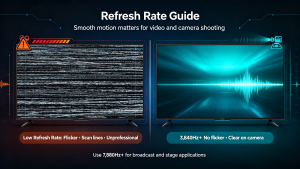
Refresh rate refers to the screen update frequency per second, which directly affects the smoothness of dynamic pictures and the shooting effect of mobile phones/cameras. Low refresh rate will cause obvious scan lines, flicker and picture lag, which greatly reduces the professional sense of display content.
-
Conventional Commercial Use: 3840Hz and above, eliminating naked-eye flicker, suitable for daily advertising and video playback
-
Professional Live Broadcast/Stage/Broadcast Grade: 7680Hz high refresh rate, no scan lines during camera shooting, ultra-smooth dynamic pictures, meeting high-standard shooting and live broadcast needs
6. Brand & Product Quality: Avoid Short-Term Failure of Low-Cost Products
The quality of LED screens varies greatly among different brands. High-quality industrial-grade LED displays have stable performance, low failure rate and long service life, while ultra-low-cost unknown brand products are prone to dead pixels, color cast and circuit failures within several months of use.
In 2026, reputable mainstream LED display brands include Absen, Unilumin, Liantronics, Royalid, etc., with mature production technology and complete quality inspection systems, and have a large number of successful engineering project cases.
Purchasing Tip: Prioritize formal suppliers with complete qualifications, real project cases and user evaluations, and do not blindly pursue low prices.
7. Full Project Budget Planning: Break Down Hidden Costs
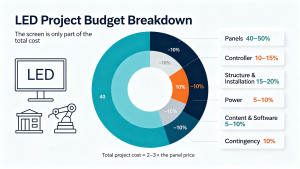
Most buyers only focus on the price of the LED screen panel, ignoring the auxiliary costs of the whole project. The total cost of a complete LED display project is often 2-3 times the price of the screen itself. The detailed cost breakdown is as follows:
-
LED display panels: 40% – 50% of the total project cost (core main equipment)
-
Controller & signal processing system: 10% – 15% (ensure stable signal transmission)
-
Mounting structure & installation construction: 15% – 20% (fixed support and on-site construction)
-
Power distribution & electrical engineering: 5% – 10% (safe power supply system)
-
Content production & control software: 5% – 10% (content release and management)
-
Project contingency fund: 10% (deal with on-site adjustment and unexpected situations)
The conventional market price of LED screen panels is $300 – $800 per square meter. It is recommended to make a full budget in advance to avoid cost overrun in the later stage of the project.
8. Warranty & After-Sales Support: Long-Term Operation Guarantee
LED screen is a long-term operating engineering product, and perfect after-sales service is the key to stable operation for many years. Regular formal suppliers provide standardized warranty and technical support services:
-
Warranty Period: The mainstream quality suppliers provide 2-3 years free warranty for LED modules, and support paid extended warranty services
-
Technical Support: Provide remote fault diagnosis, online troubleshooting and 24-hour after-sales response
-
On-Site Service: Local suppliers can provide faster on-site maintenance and debugging to shorten equipment downtime
High-quality LED screens have a service life of up to 100,000 hours. Based on 12 hours of daily use, they can work stably for more than 22 years, and reliable after-sales support can effectively extend the service life of the equipment.
Step-by-Step LED Screen Purchasing Process (2026 Standard)
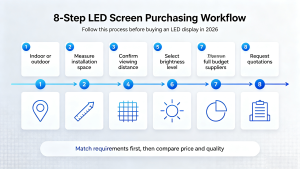
Follow the steps below to complete scientific purchasing and avoid all pitfalls:
-
Confirm the installation scenario (indoor/outdoor/semi-outdoor) to lock basic parameter standards
-
Accurately measure the installation space size and confirm the maximum screen layout range
-
Measure the actual viewing distance of the audience and match the appropriate pixel pitch
-
Determine the brightness level according to the ambient light condition
-
Make a full project budget including panels, accessories, installation and after-sales
-
Screen qualified suppliers, check brand strength and project cases
-
Sort out complete parameter requirements and send inquiries to suppliers
-
Compare at least 3 formal quotations and select the highest cost-effective solution
FAQs About LED Screen Purchase
Q1: How to quickly select the right pixel pitch?
A1: Take the actual viewing distance as the core standard, and select the corresponding pixel pitch according to the matching table in the guide. Short viewing distance corresponds to small pitch, and long viewing distance corresponds to conventional large pitch.
Q2: What are the core differences between indoor and outdoor LED screens?
A2: Outdoor LED screens have higher brightness, IP65+ waterproof and dustproof protection, and high and low temperature resistance; indoor screens focus on high definition and soft display, without weatherproof design, with lower cost and power consumption.
Q3: What is the total cost of a complete LED screen project?
A3: The panel price is $300-$800/㎡, and the total cost of the finished project including installation, accessories and debugging is 2-3 times the panel price.
Q4: What information needs to be provided for accurate quotation?
A4: Need to clarify pixel pitch, screen size, installation scenario, viewing distance, budget range and project cycle.
Final Summary
Purchasing a suitable LED screen does not depend on high parameters or low price, but on matching project requirements. Through scenario positioning, accurate parameter matching, reasonable budget planning and formal supplier selection, you can obtain a high-stability, high-cost-effective LED display solution that can operate stably for a long time.
For customized LED screen solutions and professional quotation services, you can consult our professional team to get one-stop project matching guidance.
Related Reading:
– [LED Screen on Wikipedia]— Learn the technical background of LED display technology