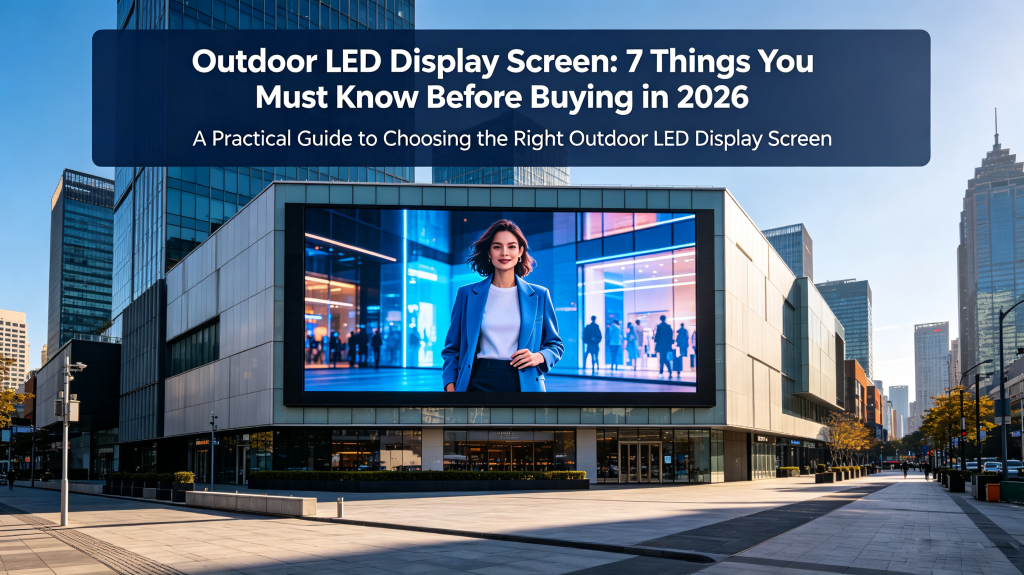
Are you looking for an outdoor LED display screen? You are not alone. More businesses are choosing this technology every year. But picking the right product can feel confusing. This guide makes it simple.
In this article, you will learn 7 key things. These will help you make a smart buying decision.
—
What Is an Outdoor LED Display Screen?
An outdoor LED display screen is a screen built for outdoor use. It uses light-emitting diodes to create bright, vivid images.
Each unit contains thousands of individual LEDs. These work together to produce their own light. This means the display stays visible day and night.
This solution is designed to handle weather. Rain, dust, and extreme temperatures do not stop it. This makes it perfect for outdoor advertising.
—
7 Key Things About Outdoor LED Display Screen Before Buying
Pixel Pitch
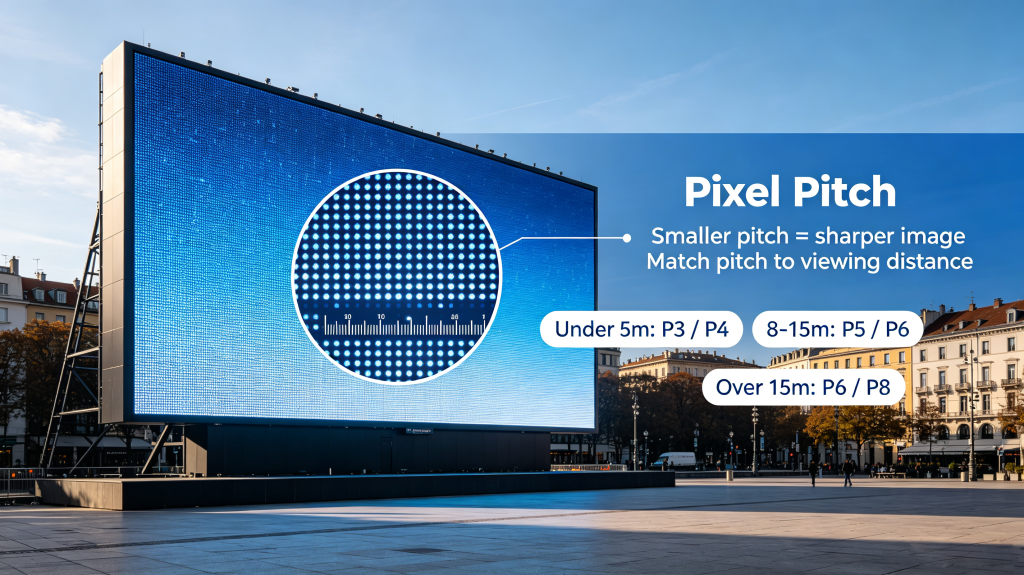
Pixel pitch is the distance between two pixels. It is measured in millimeters. A smaller number means a sharper image.
Choose a pixel pitch that matches your viewing distance. For close viewing under 5 meters, choose P3 or P4. For distances of 8 to 15 meters, P5 or P6 works well.
Always check this spec first. It is the most important factor for image quality.
Brightness
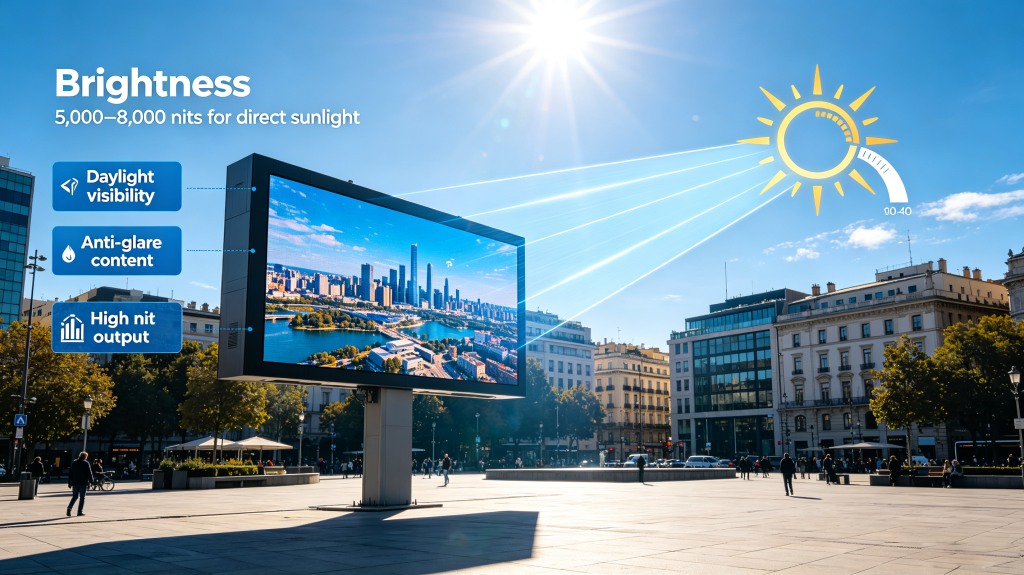
Brightness is measured in nits. A higher nit number means a brighter display.
Aim for at least 5,000 to 8,000 nits. This ensures visibility in direct sunlight. If the brightness is too low, your content will be invisible in daylight.
Brightness is critical for outdoor advertising success.
IP Rating
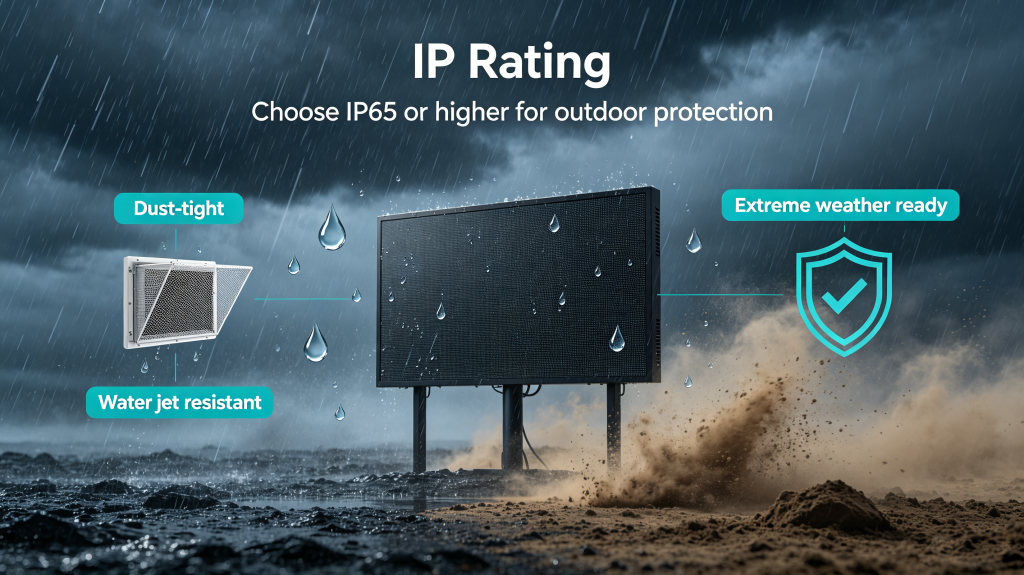
The IP rating measures weather resistance. It is critical for outdoor use.
Choose IP65 or higher. This means dust-tight and protected against water jets. Some models offer IP68 for extreme conditions.
Never use indoor screens outdoors. They lack weatherproofing and will fail quickly.
—
Resolution
Resolution determines how sharp your content looks. It is based on the total number of pixels. More pixels mean a sharper image.
Balance resolution with viewing distance. Common resolutions include 1920×1080 (Full HD) and 3840×2160 (4K).
—
Refresh Rate
The refresh rate affects how smooth motion looks. It is measured in hertz (Hz). Higher is better.
Choose at least 3,840 Hz for video content. Low refresh rates cause flickering on camera.
—
Thermal Management
Outdoor LED display screen units face extreme heat and cold. Quality thermal management is essential.
Look for built-in fans and heat sinks. Some models use passive cooling. This reduces moving parts and extends lifespan.
Ask the supplier about the operating temperature range. Standard outdoor screens work from -20°C to 50°C.
—
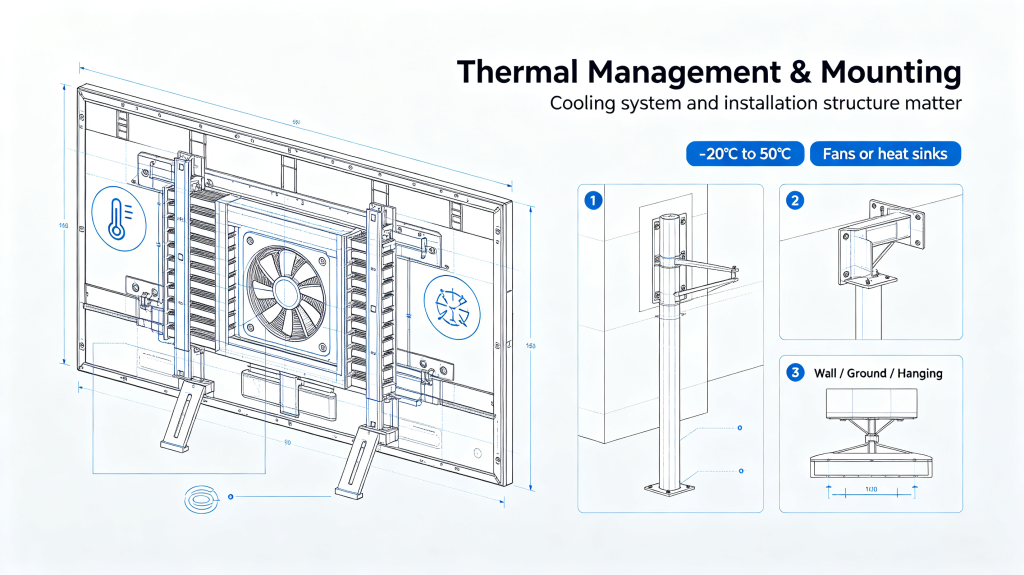
Installation and Mounting
Installation methods vary for different models.
Wall-mounted setups are common for building facades. Ground-mounted frames work for billboards. Some models support hanging installations.
Consider your space and structural requirements before buying an outdoor LED display screen.
—
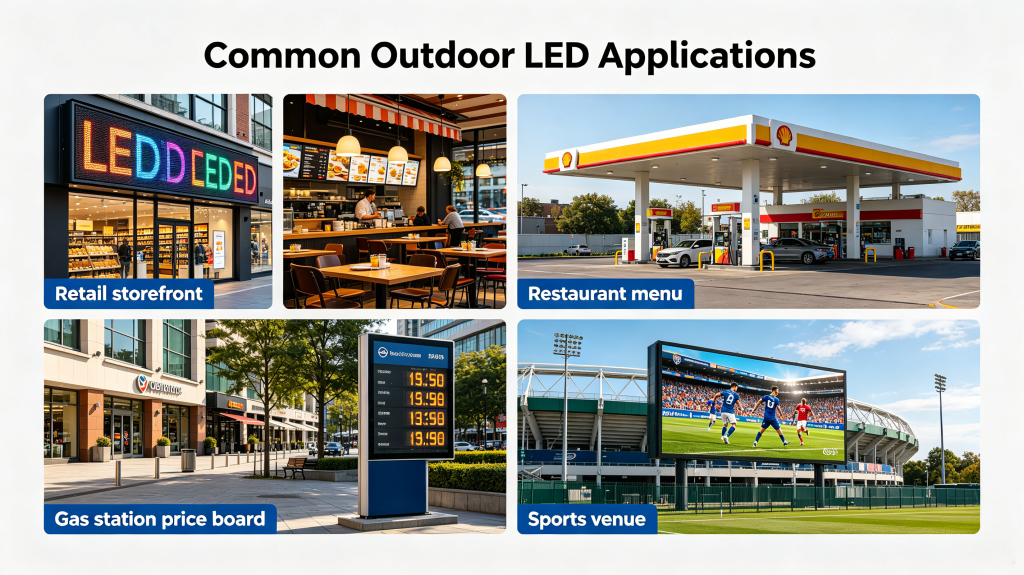
Common Outdoor LED Display Screen Applications
This technology is used in many industries. Here are the most common uses.
Retail stores use it for storefront advertising. Restaurants use it for menu displays. Gas stations use it for price boards. Corporate offices use it for lobby signage.
Sports venues, transportation hubs, and shopping malls all use this solution. Any business that wants to attract outdoor attention can benefit.
—
Outdoor LED Display Screen FAQs
Q: How long does an outdoor LED display screen last?
A: Quality units last about 100,000 hours. That is roughly 11 years at 24 hours per day. Most businesses run their displays 12 to 16 hours daily.
Q: Can it save energy?
A: Yes. Modern LED technology uses much less energy than traditional lighting. You can save up to 75% on electricity compared to neon signs.
Q: Are these displays hard to maintain?
A: Not really. Occasional cleaning is needed. Most suppliers offer remote monitoring to catch problems early.
Q: What is the best pixel pitch for outdoor use?
A: The best pixel pitch depends on viewing distance. For close viewing under 5 meters, choose P3 or P4. For longer distances, P5 or P6 works well.
—
Final Thoughts on Outdoor LED Display Screen
The outdoor LED display screen market is growing fast. Technology improves. Prices fall. Now is a great time to invest.
Know your needs. Check the pixel pitch, brightness, and IP rating. Choose a supplier who offers good support.
A well-chosen outdoor LED display screen can transform your business visibility. Take your time. Make an informed choice.
—
Related Reading:
– Explore our P3 outdoor LED display product specs
– [LED display on Wikipedia] — Learn the technical background of LED display technology