P3 Indoor LED Signage Display Optimization Tips for Venues
How to Optimize a P3 Indoor LED Display for Real Commercial Spaces
A P3 indoor LED signage display is often used in bars, restaurants, retail stores, KTV rooms, churches, stages and event venues where close viewing distance, brightness control and stable content playback matter. Many buyers choose the right screen size but lose performance because of poor content design, incorrect brightness settings, weak heat management or unclear installation planning.
Quick Answer
LED signage optimization is about matching screen brightness, content design, viewing distance, and maintenance planning to the real venue.
Basic Facts
- Focus: Operational performance
- Best use: Existing or planned indoor signage
- Key check: Brightness and content rhythm
- Risk: Great hardware with weak content
Buyer Check
Use this page as a practical project filter. Confirm the real venue, viewing distance, screen size, installation constraints, content type, and service expectations before comparing LED display prices.
Related reading: Buying guide Quality
Quick reference: This page is organized around a specific LED display buying task, practical project checks, and related LEDP3 pages so readers and search systems can understand the page purpose without relying on repeated template wording.
According to industry research, well-designed LED signage display content can increase viewer engagement by over 40%. Therefore, mastering the optimization of LED signage display not only enhances brand image but also significantly boosts business conversion rates.
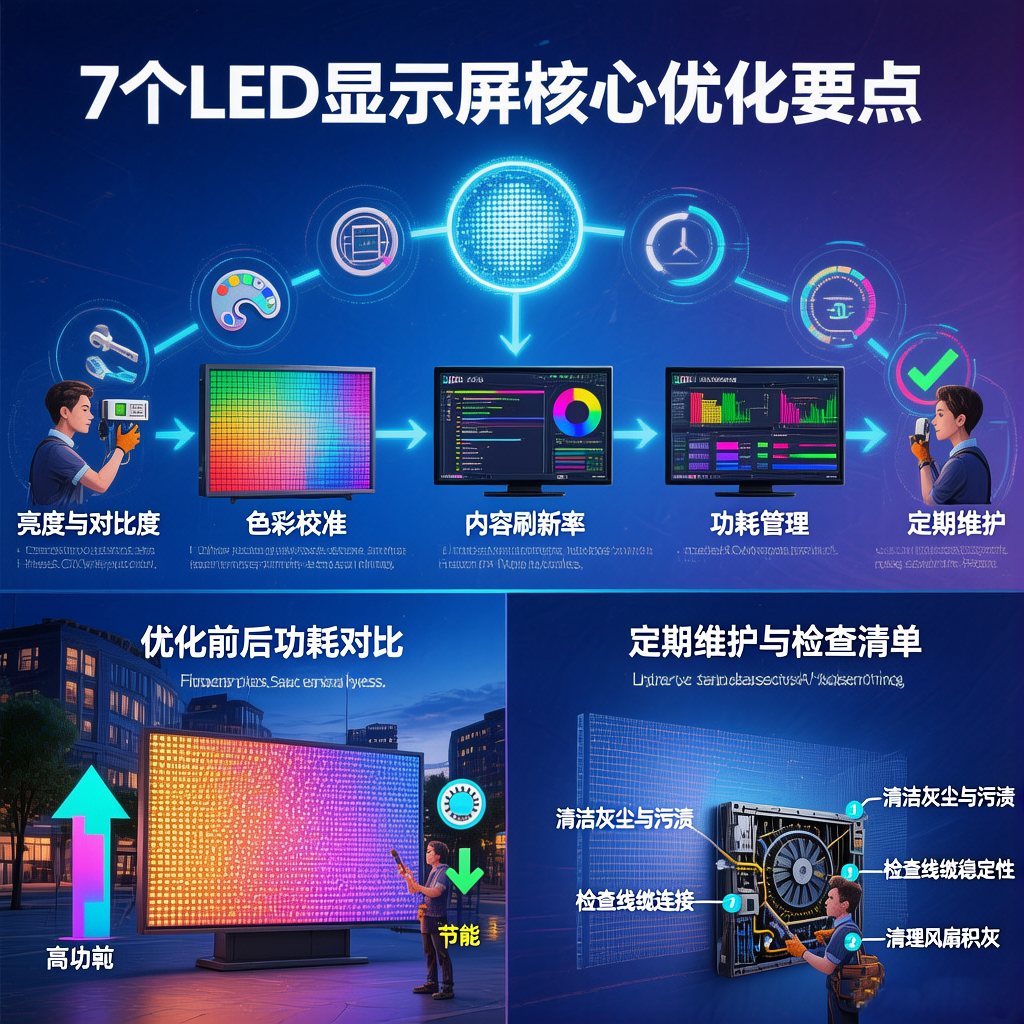
This article covers seven core dimensions of LED signage display optimization: brightness design, content creation, protection levels, installation standards, thermal management, cost control, and intelligent upgrades. Each point includes specific data standards and actionable recommendations to help you get started quickly.
2. Three Brightness Standards for LED Signage Display
LED signage display brightness directly affects the viewing experience. Insufficient brightness makes content unreadable during daytime, while excessive brightness causes eye strain and increases energy consumption.
2.1 Outdoor Brightness Standards
Outdoor LED signage display requires higher brightness to combat natural light. Authoritative standards indicate that outdoor displays need at least 2,000 cd/m² to ensure daytime visibility. For traffic signs or large billboards, this standard is particularly critical.
2.2 Indoor Brightness Control
Indoor LED signage display brightness requirements are much lower. For shopping mall wayfinding, hotel lobbies, and similar settings, brightness should be controlled between 500-1,000 cd/m² to avoid glare. Excessive brightness can actually reduce viewer comfort.
2.3 Emergency Scenario Requirements
Emergency scenarios such as fire exits require the use of fluorescent materials. These materials need to absorb light in advance and maintain a brightness of at least 0.5 cd/m² in darkness. This is a critical safety indicator that cannot be overlooked.
3. Five Golden Rules for LED Signage Display Content Creation
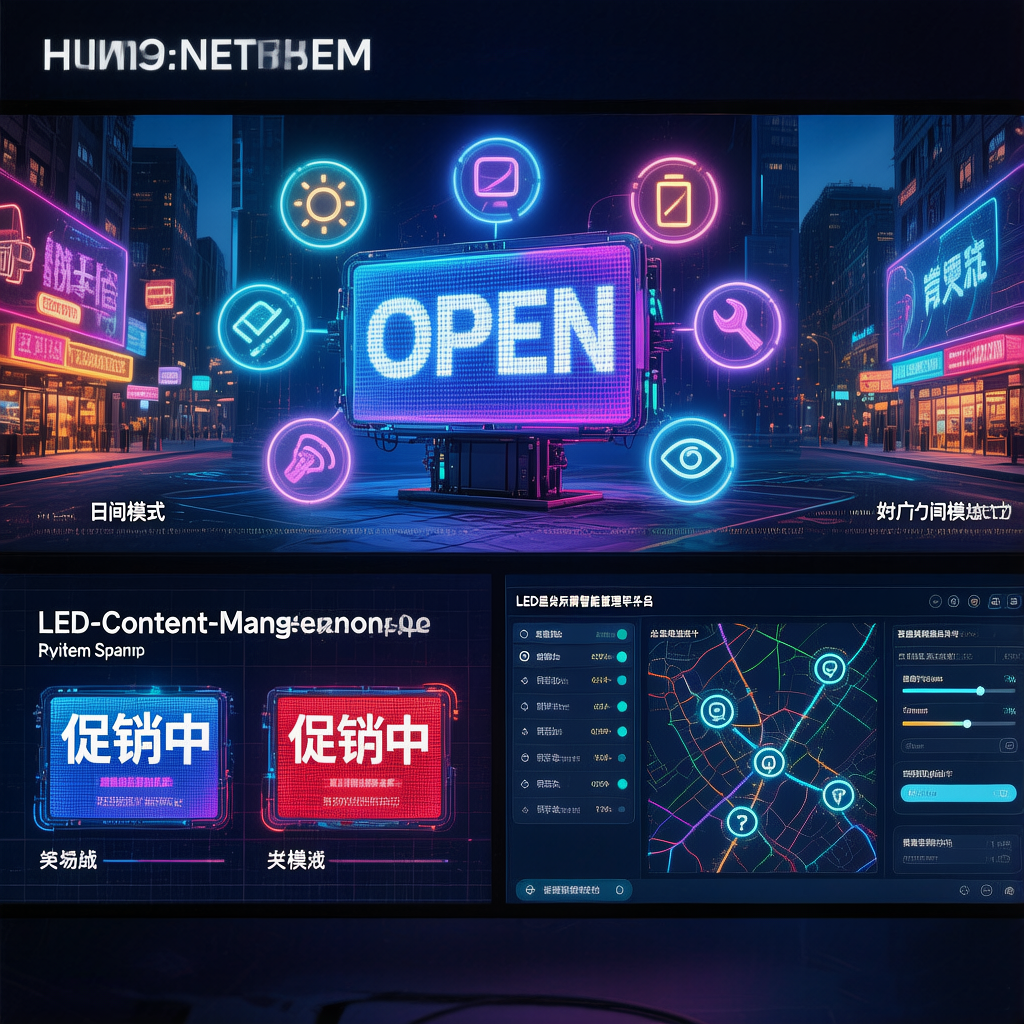
LED signage display content quality determines how long viewers pay attention. The average viewer looks at an LED screen for only 7-12 seconds. Therefore, content design must follow an efficient communication logic.
3.1 The 3:7 Ratio for Dynamic and Static Content
Dynamic and static content should follow a 3:7 ratio principle. Real-time data such as train updates and passenger flow alerts should use dynamic scrolling formats, while fixed information like fare tables and station maps are better suited for static display. Avoid using more than three animation effects on a single screen to prevent visual clutter.
3.2 Simplicity First Principle
People naturally prefer short, focused messages over long, complex sentences. Content must maintain logical clarity and conciseness. Key information must be delivered within the first three seconds.
3.3 Balancing Graphics and Resolution
Graphic size is inversely proportional to screen resolution. Lower resolution requires larger graphics. This is a core rule for ensuring readability at a distance.
3.4 Reasonable Video Length Control
Viewers of LED video walls are often in motion. Video length should be controlled to 10 or 15 seconds, depending on how long the target audience typically watches the screen. Additionally, refresh content daily to prevent viewer fatigue.
3.5 Scientific Font Selection
Choose easy-to-read fonts such as Arial. Text should be large and concise. For outdoor scenarios, prioritize sans-serif fonts like Arial or Helvetica to avoid blurring at long distances. The ideal ratio of text height to viewing distance is 1:30 (1 cm of text height corresponds to 30 cm of viewing distance).
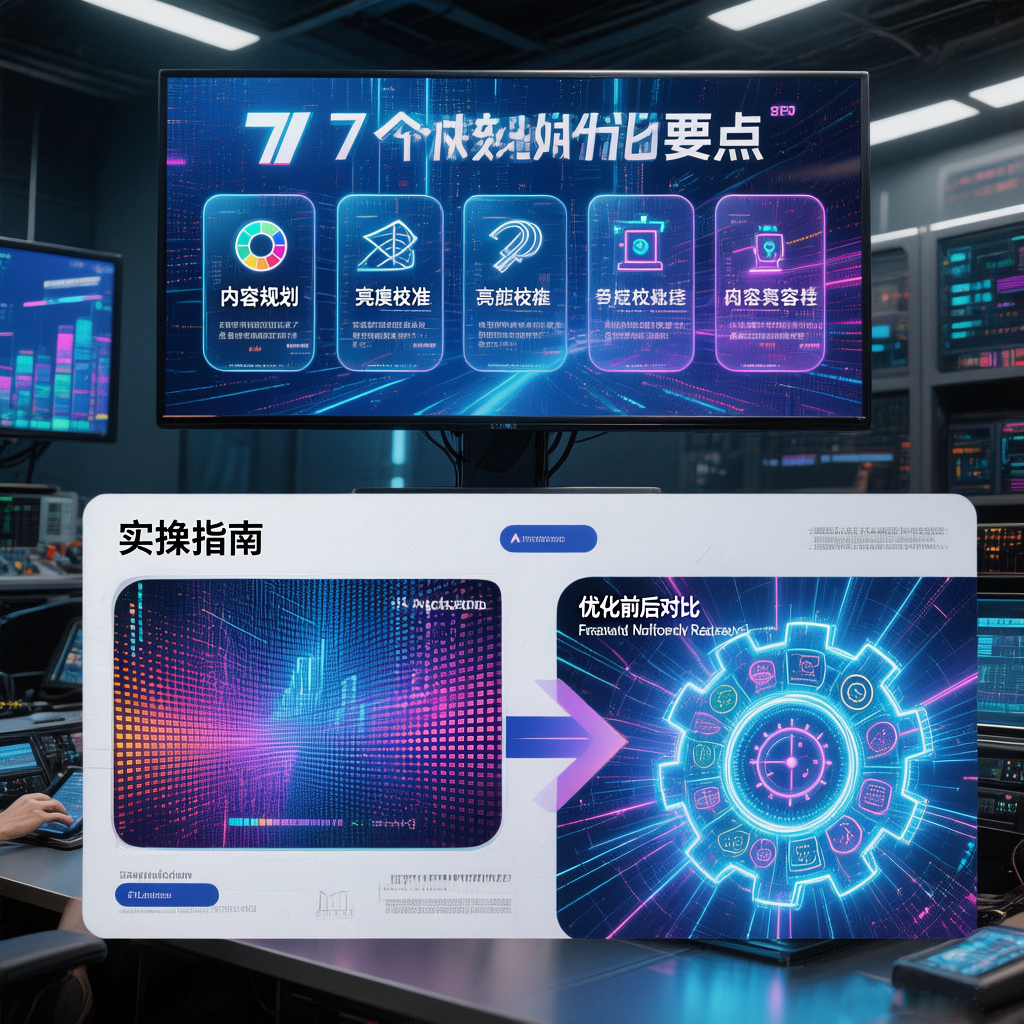
4. Two Types of Protection Levels for LED Signage Display
LED signage display protection levels directly determine equipment lifespan. Different environments require different protection standards.
4.1 IP65 Standard for Outdoor Environments
Outdoor LED signage display needs to meet IP65 or higher. This means the device is protected against water splashes and dust. Implementation methods include: filling panel and frame joints with silicone sealant, adding waterproof rubber strips at edges; using waterproof junction boxes for circuits, and installing waterproof locks at cable entry points.
4.2 IP54 Standard for Indoor Humid Environments
Indoor humid environments such as underground parking lots and car washes require IP54 protection. This level effectively prevents water spray and dust intrusion, protecting internal circuits.
5. Two Key Points for LED Signage Display Thermal Management
LED signage display thermal management directly affects LED lifespan. For every degree above 60°C, LED lifespan decreases by 50%.
5.1 Heat Dissipation Structure Design
Large-power LED signage displays (e.g., area over 5 square meters) require metal heat dissipation backplates. The backplate should be at least 2 mm thick aluminum alloy, or use a hollow frame design to accelerate air convection. Module spacing should be at least 1 cm to prevent heat buildup and light decay.
5.2 Temperature Control System
LED operating temperature should be controlled below 60°C. Temperature-controlled fans can assist with heat dissipation. For cold northern regions, power adapters should include heating films to prevent system failure due to low temperatures.
6. Three Safety Standards for LED Signage Display Installation
LED signage display installation safety is the foundation of project success. Improper installation can lead to serious accidents such as equipment falling or electrical leakage.
6.1 Wind Load Calculation
Outdoor large-scale LED signage display must be designed based on the wind pressure coefficient of the installation area. Coastal areas should follow 12-level typhoon standards, with wind pressure of at least 1.2 kPa. Base fixing bolts should be at least 10 mm in diameter, with a burial depth of at least 50 cm.
6.2 Electrical Safety Standards
Use low-voltage power supplies (DC 12V/24V) to avoid high-voltage leakage risks. Grounding resistance should not exceed 4Ω. Power cables should be routed through galvanized steel pipes for protection. These measures effectively prevent electric shock accidents.
6.3 Installation Environment Assessment
Before installation, evaluate site lighting conditions, viewing distance, viewer traffic flow, and other factors. Different scenarios have vastly different requirements for LED signage display brightness and color, which must be planned in detail before installation.
7. Four Practical Tips for LED Signage Display Cost Control
LED signage display procurement and maintenance costs should not be underestimated. Scientific cost control can save over 30% of total investment.
7.1 Modular Structure Design
Break down the signage into independent units such as panels, light source modules, and circuit modules. This allows for easy replacement of damaged components (e.g., individual LED light modules can be replaced directly). Modular design significantly reduces maintenance costs.
7.2 Energy Consumption Optimization
Install light sensors or timers to automatically adjust brightness based on ambient light. Outdoor signage can reduce brightness to 50% at night, saving 50% on electricity costs. Choose high-efficiency LED modules (e.g., COB packaging) to reduce energy consumption by 30%-50% compared to traditional light sources.
7.3 Easy-Maintenance Interface Design
Reserve maintenance access points (e.g., magnetic suction panels) to avoid dismantling the entire structure. Use quick-connect terminals for circuit connectors to reduce repair time. These designs make on-site maintenance simpler.
7.4 Content Reuse and Templates
Build a content template library to reduce repetitive creation costs. A high-quality content template can cover multiple scenarios, significantly lowering operational costs.
8. Three Directions for LED Signage Display Intelligent Upgrades
LED signage display is evolving from a simple information display tool to an intelligent interaction platform.
8.1 AI-Powered Content Recommendations
Through facial recognition technology, LED signage display can deliver personalized content. The system automatically adjusts playback content based on viewer age, gender, and other information, improving advertising conversion rates.
8.2 Adaptive Ambient Light Adjustment
Using ambient light sensors, LED displays can automatically adjust color temperature and brightness. Brightness increases during daytime and decreases at night, saving energy while maintaining comfort.
8.3 Data-Driven Information Preloading
Through big data analysis, the system can predict peak traffic periods and preload relevant information in advance. Tests show that intelligent content recommendations can improve passenger information acquisition efficiency by 40%. However, care must be taken to avoid excessive collection of personal information to prevent privacy concerns.
9. Summary: The Core Logic of LED Signage Display Optimization
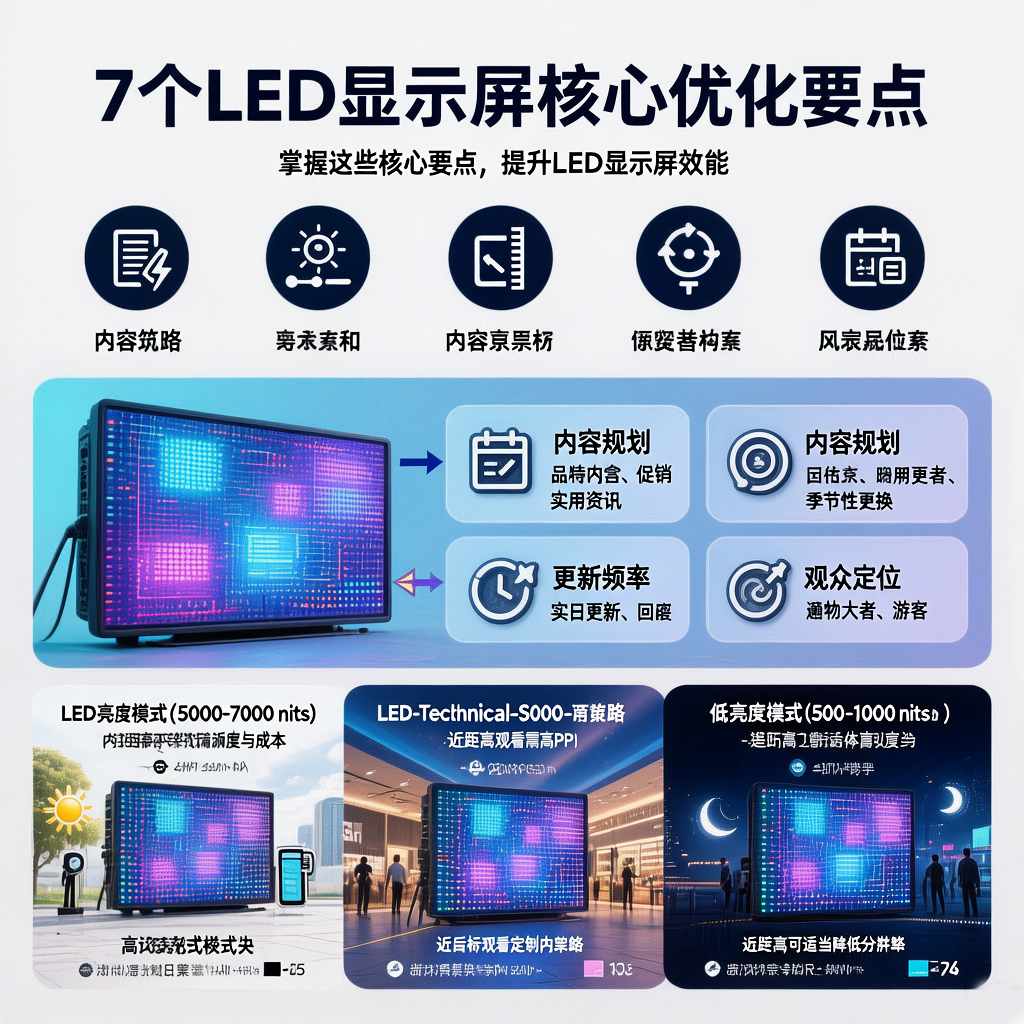
LED signage display optimization is a systematic project covering seven dimensions: brightness design, content creation, protection levels, installation standards, thermal management, cost control, and intelligent upgrades.
In short, design should follow the principle of “function first, visual assistance, durability as foundation.” Commercial signage should prioritize brightness and aesthetics, traffic signage should focus on long-distance recognition, and emergency signage should prioritize safety and reliability. Meanwhile, an effective LED signage display content strategy should be like a symphony, with a stable rhythm section (basic information), flexible melody lines (dynamic content), and timely decorative elements (commercial messages).
The Core Logic of LED Signage Display Optimization