Quick Answer: What is the Jumbotron? Jumbotron was Sony’s name for a large color video display system. Sony records a 2,000-inch Jumbotron at the 1985 Tsukuba exposition, and its 1990s reports describe systems used in stadiums, arenas and convention centers. Today, people often say “jumbotron” when they mean any giant venue screen. For a modern project, that nickname is not a specification: ask for the actual display technology, active size, pixel pitch, resolution, brightness, processing, structure, power and service plan.
The word is easy to recognize because it describes the experience: a picture large enough for a crowd. The technical meaning is less simple. The original system belongs to a particular manufacturer and period, while contemporary stadium screens may come from many suppliers and use different direct-view LED packages, cabinet systems and controllers. Understanding that distinction prevents a familiar word from turning into an incomplete request for quotation.
The Original Jumbotron: A Sony Large-Screen System
Sony’s corporate history says the Jumbotron shown at the International Exposition in Tsukuba, Japan, in 1985 measured 2,000 inches. The company presents it as a successor to an earlier light-emitting Color Video Panel concept rather than an ordinary home television enlarged to stadium scale. That source supports the date, exhibition context and size; it does not establish one permanent Jumbotron dimension.
By 1995, Sony’s annual report described Jumbotron as a “large color video display system” used to show live broadcasts, commercials and other programming. The report listed athletics stadiums, concert arenas and convention centers among its installations. Those documents explain why the name became strongly associated with crowd-scale video.
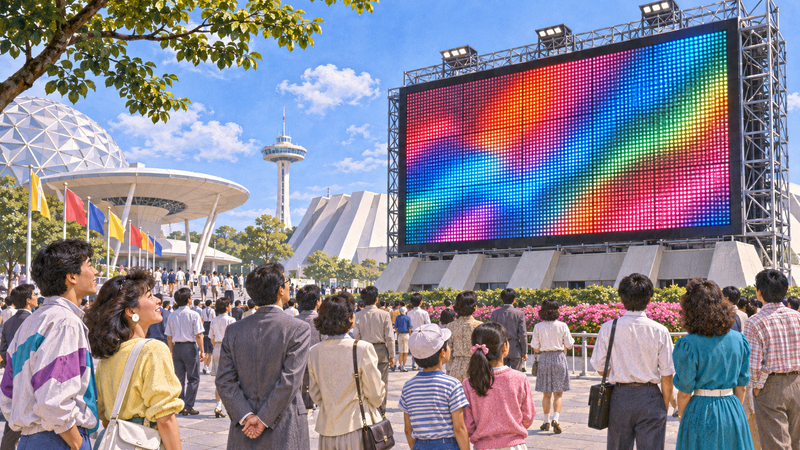
What People Mean by Jumbotron Today
In casual speech, “jumbotron” often means the large screen that shows replays, scores, close-ups, announcements or sponsor content in a sports or entertainment venue. That everyday use can be understood in conversation, but it does not tell an engineer or supplier what to build.
A current giant screen may be a direct-view LED video display, a video scoreboard that combines video and scoring areas, a cluster of screens around a center-hung structure, or another large-format system. It may be indoor or outdoor, fixed or temporary, front-service or rear-service. None of those choices follows automatically from the nickname.
When referring to the historical product, write “Sony Jumbotron large color video display system” and cite the period. When referring to a current project, use a functional term such as “outdoor direct-view LED video display” or “center-hung LED video scoreboard,” then state the requirements. This article documents historical naming and common usage; it does not offer a conclusion about current trademark law.
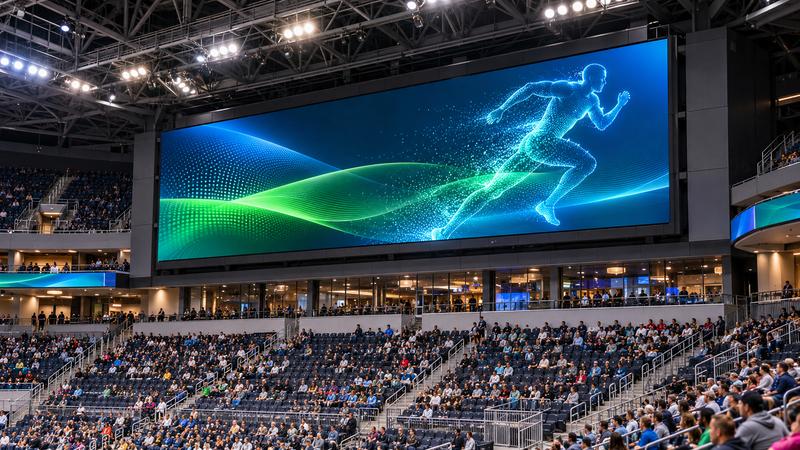
How a Modern Giant LED Screen Is Built
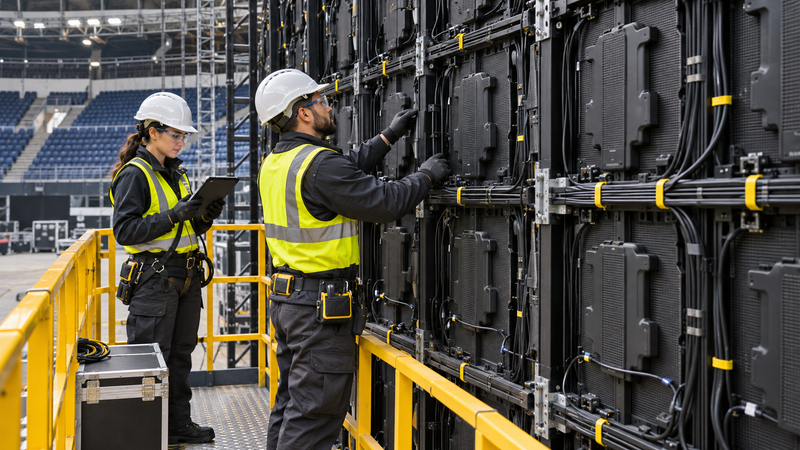
A modern direct-view LED screen is normally modular. Individual light-emitting pixels are arranged on modules; modules fit into cabinets or panels; cabinets form the active display area; power, data distribution and processing make the image appear across the combined canvas. The supporting structure and service access are part of the installed system even though they do not create pixels.
Daktronics’ LED learning material describes modules as building blocks and connects resolution with display size, pixel technology, pixel pitch and viewing distance. Pixel pitch is the center-to-center spacing between adjacent pixels. A smaller number usually places pixels more closely, but “smaller is better” is not a complete rule: content, nearest viewers, ambient light, physical size, cost and service conditions still matter.
For a real quotation, request the cabinet model, cabinet dimensions, cabinet pixel matrix, cabinet count and final total pixel canvas. Also request calibrated brightness, refresh and grayscale information where relevant, viewing-angle data, environmental rating for the site, maximum and typical power information, access direction, processor scope, redundancy and spare-parts plan. A current vendor specification sheet illustrates why these are separate fields; its numbers apply only to that product.
Jumbotron, Video Wall, Scoreboard and Projection Compared
| Term | Useful meaning | What it does not specify |
|---|---|---|
| Sony Jumbotron | Historical Sony large color video display system | The specification of a current screen from another supplier |
| Jumbotron, casual use | General reference to a very large venue screen | Technology, dimensions, pixels, brightness or control |
| Direct-view LED video display | Image formed directly by an LED pixel surface assembled from modules or cabinets | The exact pitch, resolution, environment rating or service design |
| Video scoreboard | Venue system combining video, scoring, timing or information functions | Whether every area uses the same technology or resolution |
| Projection screen | Separate projector throws an image onto a surface | The behavior of a direct-view LED system |
| LCD video wall | Multiple flat panels tiled into a larger image area | A seamless LED cabinet surface or outdoor stadium capability |
The correct term depends on the decision being made. A fan can point to “the jumbotron.” A venue brief should say which video, scoring and information functions are required. A supplier comparison should identify the actual display and control architecture. If the use is a temporary production, our big LED screen for stage guide covers additional event questions.
A Size and Resolution Example
There is no single Jumbotron size. Consider a hypothetical modern LED image area 14.4 m wide and 8.1 m high, which has a 16:9 shape. At a 10 mm pitch, a simple division gives 1,440 pixels across and 810 pixels high, or 1,166,400 total pixels. This is an author-calculated teaching example, not a recommended stadium specification or an LEDP3 stocked configuration.
14,400 mm ÷ 10 mm = 1,440 pixels wide
8,100 mm ÷ 10 mm = 810 pixels high
1,440 × 810 = 1,166,400 displayed pixels
The same physical dimensions at a different pitch produce a different pixel canvas. The same canvas can also be displayed at different physical sizes. AVIXA’s discussion of open-space LED walls notes that pitch affects resolution, viewing distance and cost. Use representative content and actual viewer positions rather than converting one rule of thumb into a guaranteed result.
The processor may accept a 1920 × 1080 or 3840 × 2160 source, but the display still maps that source to its physical pixel canvas. Input format and displayed resolution are related but not identical. For more on proportions, see our 16:9 LED wall dimensions guide.
What to Put in a Modern Large-Screen Brief
Replace “we need a jumbotron” with a short record of the viewing task and site. State whether the system must show live video, replays, scoring, sponsor content, text or a mix. Mark the nearest and farthest important viewers, the available image area, sightlines and any camera use.
- Site: indoor or outdoor conditions, ambient light, weather exposure and operating schedule.
- Image area: active width, height and aspect ratio, separate from total structure dimensions.
- Pixel canvas: proposed pitch, cabinet matrix, total pixels and content-mapping treatment.
- Visual performance: calibrated brightness, dimming, refresh, grayscale and viewing-angle evidence suited to the task.
- System scope: processor, sources, scoring or show-control integration, fiber or data distribution and monitoring.
- Installation: qualified structural and electrical design, access, ventilation, rigging where applicable and local approvals.
- Operation: acceptance tests, training, spares, response responsibilities and maintenance access.
Ask bidders to identify exclusions and the exact configuration behind every performance claim. A photograph of another stadium, a maximum headline, or the word “Jumbotron” does not prove that a proposed system meets your venue’s task. For temporary booths, compare the narrower checklist in our trade-show LED video wall guide.
Primary and Technical Sources
- Sony corporate history: the 2,000-inch Jumbotron shown at Tsukuba Expo ’85
- Bureau International des Expositions: Expo 1985 Jumbotron dimensions and display context
- Sony Annual Report 1995: Jumbotron venue uses and installations
- Daktronics product documentation: LED display modules, pixel arrays, and driver circuitry
- AVIXA: pixel pitch, viewing distance, and resolution
The historical links document specific Sony systems and Expo records; they are not specifications for a current LED project. The Daktronics and AVIXA links explain modern display components and pitch concepts but do not certify a proposed LEDP3 configuration.
Jumbotron Questions
Is Jumbotron a generic name for every large screen?
Historically, Jumbotron was Sony’s name for its large color video display system. People now often use the word casually for giant venue screens, but not every current stadium display is a Sony Jumbotron. In project documents, name the actual technology and system requirements.
Are modern Jumbotrons made from one giant panel?
Modern direct-view LED venue screens are generally modular, using LED modules and cabinets assembled into a larger active area. The structure, data, power, processing and service design complete the system.
How big is a Jumbotron?
There is no one fixed size. Sony documents a 2,000-inch Jumbotron at Expo ’85, while modern venue displays vary with the building, audience, content and system design. Compare active dimensions and total pixels rather than the nickname alone.
What term should I use in a supplier request?
Use a functional term such as “outdoor direct-view LED video display” or “center-hung LED video scoreboard,” then state the size, pitch, pixel canvas, brightness, control, structure, power, access and support requirements.
Evidence note: Sony sources support the historical system, 1985 exhibition and 1990s venue uses. Daktronics and AVIXA sources support the modern modular-display and pixel-pitch explanation. The worked resolution example is hypothetical and no trademark-status opinion, price, certified design or measured client result is claimed.